Transit Passport
// Standards · Battery Transit
Transit Passport
A shop's own bench readings, sealed into a record that travels with the crate. A forwarder, customs officer or buyer scans one label and sees state of charge, damage status, the UN 38.3 reference and every hand-off since sealing.
No charge to the shop. The shipper or buyer pays $15 per module from the passport link; custody scans open once paid.
Passports sealed
—
Custody scans
—
C · Transit — Evidence chain
Bench To Border
- 01
Bench
The origin shop measures each module: state of charge, rest voltage, internal resistance and casing isolation.
max_soc_percentocv_vir_mohmisolation_mohm - 02
Seal
The readings, UN number, damage status and shipper are hashed with SHA-256 and chained to that shop's previous passport.
event_hashprev_hash - 03
Label
A 4×6 thermal label carries the QR link and Code 128 crate ID. It sits beside the Class 9 label, never over it.
passport_code - 04
Custody
Each forwarder, warehouse, carrier or customs scan appends a hop hashed onto the one before it.
hop_hashlocation_label - 05
Arrival
The buyer reads the same record. Repurposed modules carry the donor reference an EU passport must link to.
donor_reference
Shop readings are the shop's measurements. HHN checks the entries, seals them and keeps the chain — it does not test the modules itself.
Packing — what the passport records
Crate Anatomy
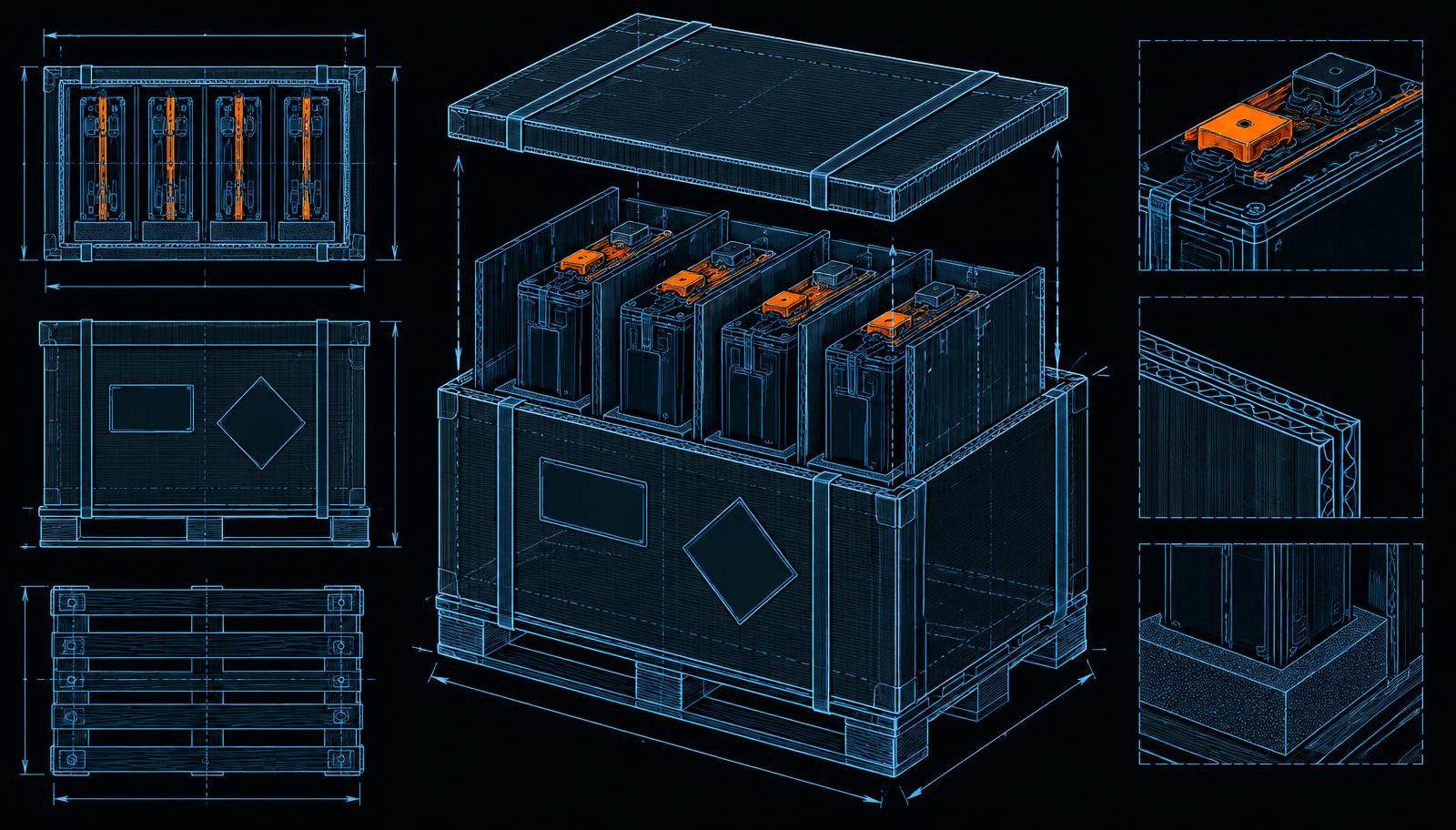
01 / 10
Terminal caps
Every positive and negative terminal is covered with a non-conductive cap so no terminal can touch another or the box. The shop ticks this before sealing.
49 CFR 173.185 · eCFRSourced — check each against the current text
The Rules
Battery passport required from 18 Feb 2027 for EV, LMT and industrial batteries over 2 kWh · Reg. 2023/1542 Art. 77
Regulation (EU) 2023/1542 · EUR-LexRepurposed or remanufactured battery gets a new passport linked to the original · Art. 77(7)
Regulation (EU) 2023/1542 · EUR-LexCommission battery passport Registry opened for testing on 20 Jul 2026
European Commission · Battery Passport FAQPassport data split: public, legitimate-interest and authorities-only · Annex XIII
Regulation (EU) 2023/1542 · EUR-LexUN 3480 lithium ion shipped alone by air: at most 30% state of charge · PI 965
IATA Lithium Battery Guidance 2026Since 1 Jan 2026: UN 3481 packed with equipment over 2.7 Wh must ship at 30% SoC or less · 67th Ed. PI 966
JAL Cargo · DGR 67th Edition noticeSince 1 Jan 2026: UN 3556 vehicles with batteries over 100 Wh at 30% SoC or 25% indicated capacity
Lion Technology · 2026 SoC limitDamaged, defective or recalled lithium batteries are forbidden on aircraft · 49 CFR 173.185(f)
49 CFR 173.185 · eCFRLithium cell and battery types must pass UN 38.3; a test summary must be available
IATA · Lithium battery fact sheetThe 30% limit for UN 3480 shipped alone has applied by air since 2016; the 2026 edition extended it to batteries packed with equipment and to vehicles. Air carriers can add stricter rules of their own.
EU Battery Passport · Reg. 2023/1542 Annex XIII
EU Intake
What an operator gathers before an EU passport can be issued for a surplus or repurposed module. HHN bench readings cover the health rows; the maker or operator supplies the rest. HHN does not issue EU passports.
A · Public
Identity & Provenance
- Economic operator — Legal name, trade name, address and EU EORI or tax ID of whoever places the module on the market
- Module identifiers — Maker, original part number, batch or serial, date and place of manufacture
- Battery category — EV, light means of transport, industrial over 2 kWh, or stationary storage
- Prior passport link — Original passport ID when the module is repurposed or remanufactured (Art. 77(7))HHN bench
B · Public & authorised
Performance
- Rated capacity & voltage — Nominal, minimum and maximum voltage; rated Ah and kWh
- Chemistry — Cathode, anode and electrolyte
- State of health — Remaining capacity, internal resistance and cycle count measured at intakeHHN bench
- Expected lifetime — Projected cycle and calendar life under stated conditions
C · Public & recycler
Materials
- Carbon footprint — Lifecycle kg CO2e per kWh and performance class
- Recycled content — Recovered cobalt, lithium, nickel and lead shares, or proof of exempt older stock
- Substances of concern — Hazardous substances above regulatory thresholds
D · Authorised & recycler
Safety & End of Life
- Test reports — UN 38.3 test summary, CE declaration and safety test documents
- Isolation & damage status — Casing isolation reading and damaged / defective / recalled status at sealingHHN bench
- Dismantling & safety — Exploded views, high-voltage disconnect steps and extinguishing agent for responders and recyclers
Attestation vs. legal sign-off
Certifications
HHN keeps records; the shipper signs for hazmat. Keeping those two jobs separate is what lets a shop use a passport without HHN taking over the shipper's legal duties.
Not required
What HHN Is Not
Not the shipper
HHN never packs, marks, offers or carries a crate. It keeps a record of what the shop measured and who handled the crate after sealing.
Not a test lab
HHN does not run UN 38.3 drop, vibration or thermal tests. The record links the maker's own UN 38.3 test summary, which shippers of lithium cells must be able to provide.
49 CFR 173.185 · eCFRNot an EU filing
HHN does not issue EU battery passports or file to the Commission Registry. It prepares the bench rows the economic operator needs.
Regulation (EU) 2023/1542 · EUR-Lex
Legal sign-off
Who Signs
The shipper is the offeror
The person offering the crate signs the shipper's certification on the dangerous goods declaration. A passport never replaces that signature.
49 CFR 172.204 · eCFRTrained staff only
Anyone who classifies, packs, marks or signs for hazmat must hold current hazmat training from their employer.
49 CFR 172.704 · Hazmat training · eCFRAttestation wording
Every record reads: telemetry and safety measurements attested by the origin shop; cryptographic integrity verified by Hybrid Hub Network.
Optional · builds trust
Credentials
Lithium battery shipper course
A DOT 49 CFR / IATA DGR lithium course lets the founder speak the same language as forwarders and airlines. It is training, not a licence to ship for others.
49 CFR 172.704 · Hazmat training · eCFRGS1 company prefix
Lets HHN QR links follow GS1 Digital Link, a common way to put a product identifier in a web QR. The EU passport identifier standard is still being finalised.
GS1 Digital Link standardWhere to register
GS1 US issues company prefixes and single identifiers to US businesses; check their current price list before buying.
GS1 US · Company prefix
Attestation notice · printed on every record
Telemetry and safety measurements attested by the origin shop named on the record; cryptographic integrity verified by Hybrid Hub Network. The shipper remains the offeror and signs the dangerous goods declaration.
One credit = one module
Pricing
Every option is priced per module against the $15.00 standard rate. The origin shop never pays to seal. Packs and plans put credits on your shipper account; spend them from any passport link.
Standard
Pay As You Go
$15.00/ module
1 module · $15.00 per module
Paid per crate from the passport link. No account or commitment.
Pay from any sealed passport's link
One-time pack
Exporter Pack
$120.00one-time
10 modules · $12.00 per module · 20% under standard
10 module credits, one-time. Credits do not expire.
Buy packMonthly plan
Wholesaler Pro
$499.00/ month
50 modules · $9.98 per module · 33% under standard
50 module credits added each month the plan renews. Unused credits stay on the account.
SubscribeMonthly plan
Logistics & 3PL
$2,500.00/ month
500 modules · $5.00 per module · 67% under standard
500 module credits added each month the plan renews. Unused credits stay on the account.
SubscribeSurplus · repurposed · harvested
Surplus Modules
- 01
Stranded stock
Surplus, overstock and harvested modules often have no factory passport. From 18 Feb 2027 an EV, LMT or industrial battery over 2 kWh placed on the EU market needs one.
- 02
New operator
Whoever repurposes, remanufactures or places a module on the market becomes the economic operator responsible for its passport.
- 03
Linked lineage
A repurposed battery gets a new passport that links to the original. The Transit Passport donor reference carries that link from the bench.
- 04
HHN's part
The shop's intake readings, A–D data and custody are kept in one sealed record the operator can hand to their passport issuer.
Same check the seal applies
Air Check
Enter your own numbers. Nothing is saved. This is the order of checks used when a shop seals a passport.
Enter a state of charge to see the result.
4 × 6 in · 101.6 × 152.4 mm · thermal
Crate Label
Scan · live record & custody
Bench
UN 38.3
Sealed
Shipper
Packing
Blank layout · fields fill when a shop seals a crate
- 01
Header
Network and document name in heavy type so a dock worker can tell it from carrier labels.
- 02
QR
Opens the live record. Works on any phone, no app or login.
- 03
UN number
UN 3480, 3481, 3556 or 3496 with its proper shipping name.
- 04
State of charge
Highest module reading at sealing and whether it is within the air limit.
- 05
DDR
The shop's damaged/defective/recalled declaration.
- 06
Contents & bench
Module count, chemistry, rated energy, resistance range and isolation.
- 07
Origin, shipper, packing
Who sealed it, who ships it, and the terminal-cap and divider checks.
- 08
Hash & barcode
Short seal hash and a Code 128 crate ID that existing warehouse scanners read.
Record format
Passport Fields
Identity & lineage
| Field | Meaning | Supplied by | Public |
|---|---|---|---|
| Passport code | TP- code on the label and in the QR link | HHN | Public |
| Origin shop | The HHN-approved shop that measured and sealed the crate | HHN record | Public |
| Module serials | Each module's serial, unique within the passport | Shop | Private |
| Donor reference | Prior passport, pack code or VIN-free donor ID for repurposed modules (EU Art. 77(7)) | Shop | Public |
Hazmat & transport
| Field | Meaning | Supplied by | Public |
|---|---|---|---|
| UN number | UN 3480, 3481, 3556 or 3496 (NiMH) | Shop | Public |
| Packing instruction | e.g. PI 965 for UN 3480 by air | Shop | Public |
| Transport mode | Air, sea, road or rail — the air SoC check only applies to air | Shop | Public |
| DDR status | Damaged, defective or recalled — DDR lithium is refused for aircraft | Shop | Public |
| UN 38.3 summary | Reference or link to the maker's test summary (lithium only) | Shop | Public |
| Shipper | The person or company who signs the dangerous goods declaration | Shop | Public |
Bench proof
| Field | Meaning | Supplied by | Public |
|---|---|---|---|
| State of charge | Per module; the passport shows the highest | Shop instrument | Public |
| SoC method | Cycler discharge, BMS reading or rest-voltage chart | Shop | Public |
| Rest voltage | Per module; public view shows the range | Shop instrument | Public |
| Internal resistance | Per module in mΩ; public view shows the range | Shop instrument | Public |
| Isolation | Casing-to-terminal resistance in MΩ and the test voltage | Shop instrument | Public |
Custody
| Field | Meaning | Supplied by | Public |
|---|---|---|---|
| Seal hash | SHA-256 of every field above plus the shop's previous passport hash | HHN | Public |
| Custody hops | Who scanned, their role, where and when — each hop hashed onto the last | Scanner | Public |
| Revocation | Only the origin shop can revoke; the record stays, marked revoked | Origin shop | Public |
Per-module serials and raw readings stay with the origin shop. The public record shows counts, ranges and the highest state of charge. These fields cover transit; the full EU passport data list is on Battery Passport. Guides: EU Passport 2027 · Shipping Guide.
One record, six readers
Who Scans
Origin Shop
Measures, packs and seals. Turns harvested modules into stock a buyer can check.
Exporter
Ships pallets with one record per crate instead of loose test sheets.
Forwarder
Scans at the dock and sees state of charge and DDR status before accepting.
Carrier
Logs pickup and delivery hops on the same chain.
Customs
Reads the UN number, packing, shipper and lineage without logging in.
Buyer
Sees the bench readings and every hand-off since the crate was sealed.
Read before shipping
The Limits
- · The shipper stays the shipper. The dangerous goods declaration is signed by the trained shipper, not HHN (49 CFR 172.204).
- · A passport is not carrier acceptance, a state approval, an EU Registry filing or a UN 38.3 test.
- · Readings come from the origin shop's instruments. HHN does not measure them.
- · Only HHN-approved shops can seal. Anyone signed in can log a custody scan they performed; only the origin shop can revoke.
- · Sealed records and custody hops cannot be edited or deleted.
Ownership
The Transit Passport record format, sealing sequence and custody chain are the work of Hybrid Hub Network. Bench readings belong to the shop that measured them. Sealing runs on HHN's servers; the browser only sends the shop's entries.
© 2026 Hybrid Hub Network · $15.00 per module, paid by shipper or buyer