Live Signals
Signal Path
With supported hardware and owner consent, Pulse captures available vehicle signals, Oracle adds trend and fault context, and the shop receives a pre-arrival assessment. Final diagnosis remains with a qualified technician.
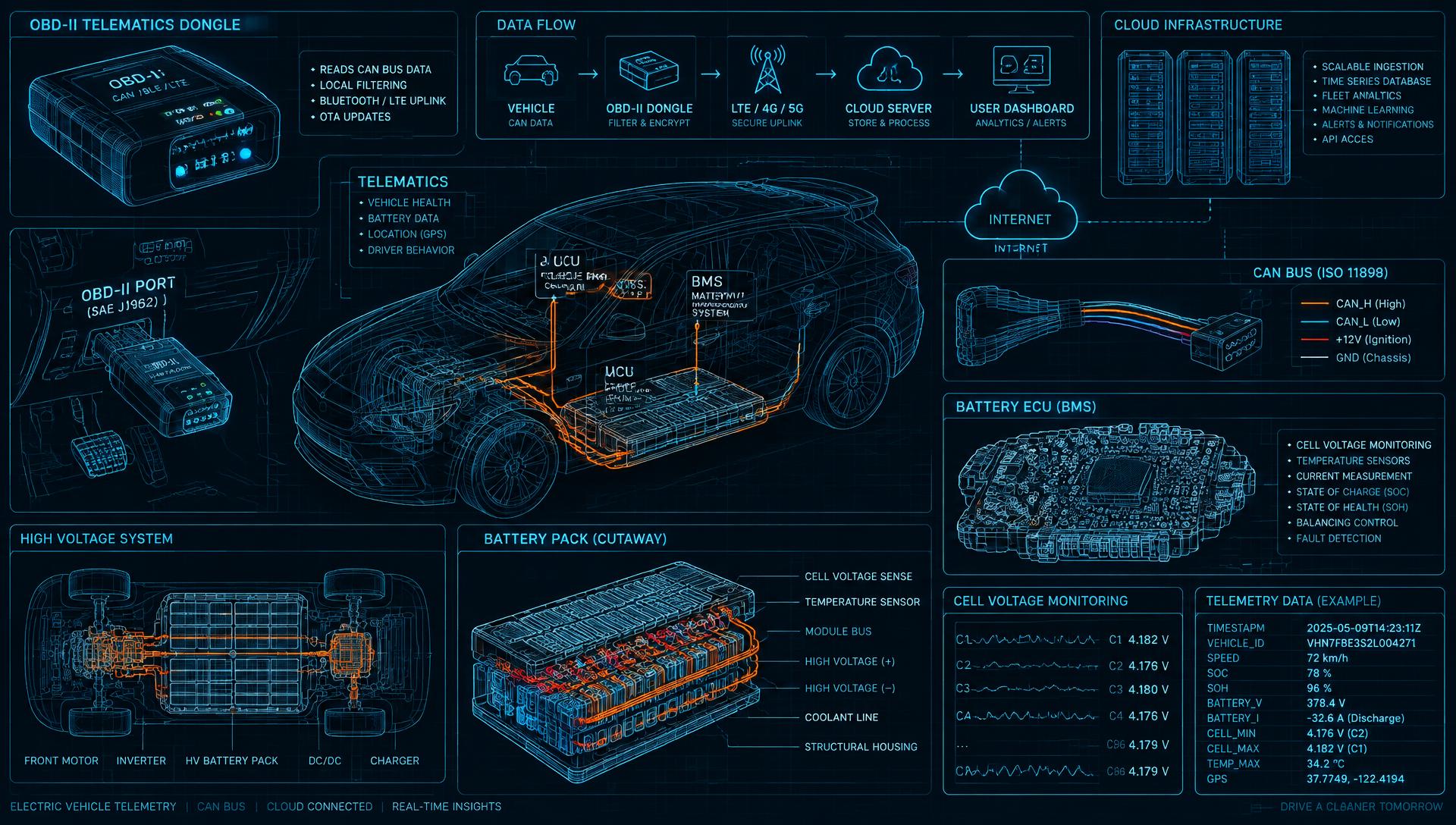
Deterministic reference benchmark — the same fixed sweep on every visit, not a vehicle reading. Production values require a supported dongle or vehicle-cloud connection and owner consent.
- Source
- CAN bus via PulseLink dongle or vehicle cloud
- Capture rate
- 100 ms on-vehicle · 1 s dashboard refresh
- Cloud persist
- 1 sample / 5 s, encrypted in transit
- Consent boundary
- Owner approves each signal; shops see service signals only
Shop verifies state of charge, contactors, and load response.
Owner receives a service alert; shop prepares module-level testing.
Shop checks airflow and cooling operation before high-load service.
Used to estimate arrival energy and safe diagnostic sequence.
Load context separates active demand from resting pack behavior.
High-voltage work is blocked until isolation is tested and restored.
Direct ingest sequence
- T+0.0sVEHICLEhhn_node_01 // [WAIT] PulseLink captures CAN frame burst
- T+0.4sPHONEhhn_node_01 // [WAIT] Encrypted relay → HHN cloud (cellular)
- T+1.1sHHN AIhhn_node_01 // [WAIT] Oracle decodes 192 cells + thermals
- T+1.6sSHOPhhn_node_01 // [WAIT] Service bay dashboard updated — bay #3 staged
- T+2.1sCUSTOMERhhn_node_01 // [WAIT] Push: 'Battery report ready · est. 3.5h service'
- T+2.4sLEDGERhhn_node_01 // [WAIT] Snapshot hashed → Hub Ledger #0x9af2…
- Owner taps Connect and signs in with their automaker account
- Owner approves each permission on the automaker's consent screen
- HHN receives a revocable access token — never the owner's password
- Readings refresh on the vehicle's own reporting schedule
- Read odometer and battery level / range
- Read location (optional, used only for Lifeline dispatch)
- Read vehicle info: make, model, year, VIN
- Owner can revoke any permission at any time from Driver Profile
- Oracle trend on the owner's Driver Profile
- Service-only summary shared with the owner's chosen shop
- Registry history entry tied to the VIN
- Signals the vehicle does not report are shown as Unavailable, never estimated
Plug In PulseLink
A small HHN device clicks into your car's OBD-II port — the same port every mechanic uses. No tools, no install, ten seconds.
Drive & Stream
Pair it once with the Pulse app on your phone. As you drive, it quietly streams thousands of battery data points — cell voltages, pack temps, inverter load — straight to the HHN cloud.
Pre-Arrival Diagnosis
Before you even pull in, Oracle AI has already read the data and built a battery health report, fault list, and parts pull-list. You see plain English. Your tech sees the full schematic.
Service With Confidence
Arrive at a Hub Certified shop where the bay is already staged, modules are already picked, and the work is logged to the Hub Ledger. Done in hours — not days of guessing.
Six live signals. Zero guessing.
- Source
- Battery ECU via OBD-II
- Timing
- Every 1.2s while driving
- Alerts
- Flags when any cell drifts 0.3V from the pack average
- Source
- Factory temp sensors
- Timing
- Every 1.2s while driving
- Alerts
- Flags above 113°F or a 15°F spread between zones
- Source
- Inverter ECU via OBD-II
- Timing
- Continuous while driving
- Alerts
- Flags sustained load outside the model's normal band
- Source
- Vehicle diagnostic bus
- Timing
- The moment a code sets
- Alerts
- Any hybrid-system code triggers an alert
- Source
- Counted from your driving data
- Timing
- Updated after every trip
- Alerts
- Feeds the long-term wear curve — no single alert
- Source
- Cooling system sensors
- Timing
- Every 1.2s while driving
- Alerts
- Flags weak flow or a failing pump before the pack cooks
No proprietary tools. No dealer-only access. PulseLink reads what the car already broadcasts and adds context — historical baselines, fleet-wide failure patterns, and module-by-module degradation curves — so a fault isn't just a code, it's a fix.
Your car. Your data. Your call.
- You turn it on
Nothing streams until you pair the device and approve sharing in the Pulse app.
- You can turn it off
Revoke access any time. Streaming stops immediately and your history stays yours to export or delete.
- Only what the car broadcasts
PulseLink reads standard diagnostic data. It never writes to the car and never touches personal data like location history beyond your trips.
Same alert. Two views.
- You see
A plain-language alert: what's happening, how urgent it is, and what to do next — park it, drive gently, or book a bay.
- Your shop sees
The full technical picture: fault codes, cell voltages, thermal maps, and a parts pull-list — before you arrive.
- Nothing is automatic
No part is ordered and no bay is booked until you approve it. Final diagnosis always stays with a qualified technician.
Deterministic reference benchmark — the same fixed sweep on every visit, not a vehicle reading. Production values require a supported dongle or vehicle-cloud connection and owner consent.
- Source
- CAN bus via PulseLink dongle or vehicle cloud
- Capture rate
- 100 ms on-vehicle · 1 s dashboard refresh
- Cloud persist
- 1 sample / 5 s, encrypted in transit
- Consent boundary
- Owner approves each signal; shops see service signals only
Shop verifies state of charge, contactors, and load response.
Owner receives a service alert; shop prepares module-level testing.
Shop checks airflow and cooling operation before high-load service.
Used to estimate arrival energy and safe diagnostic sequence.
Load context separates active demand from resting pack behavior.
High-voltage work is blocked until isolation is tested and restored.
Direct ingest sequence
- T+0.0sVEHICLEhhn_node_01 // [WAIT] PulseLink captures CAN frame burst
- T+0.4sPHONEhhn_node_01 // [WAIT] Encrypted relay → HHN cloud (cellular)
- T+1.1sHHN AIhhn_node_01 // [WAIT] Oracle decodes 192 cells + thermals
- T+1.6sSHOPhhn_node_01 // [WAIT] Service bay dashboard updated — bay #3 staged
- T+2.1sCUSTOMERhhn_node_01 // [WAIT] Push: 'Battery report ready · est. 3.5h service'
- T+2.4sLEDGERhhn_node_01 // [WAIT] Snapshot hashed → Hub Ledger #0x9af2…
- Owner taps Connect and signs in with their automaker account
- Owner approves each permission on the automaker's consent screen
- HHN receives a revocable access token — never the owner's password
- Readings refresh on the vehicle's own reporting schedule
- Read odometer and battery level / range
- Read location (optional, used only for Lifeline dispatch)
- Read vehicle info: make, model, year, VIN
- Owner can revoke any permission at any time from Driver Profile
- Oracle trend on the owner's Driver Profile
- Service-only summary shared with the owner's chosen shop
- Registry history entry tied to the VIN
- Signals the vehicle does not report are shown as Unavailable, never estimated
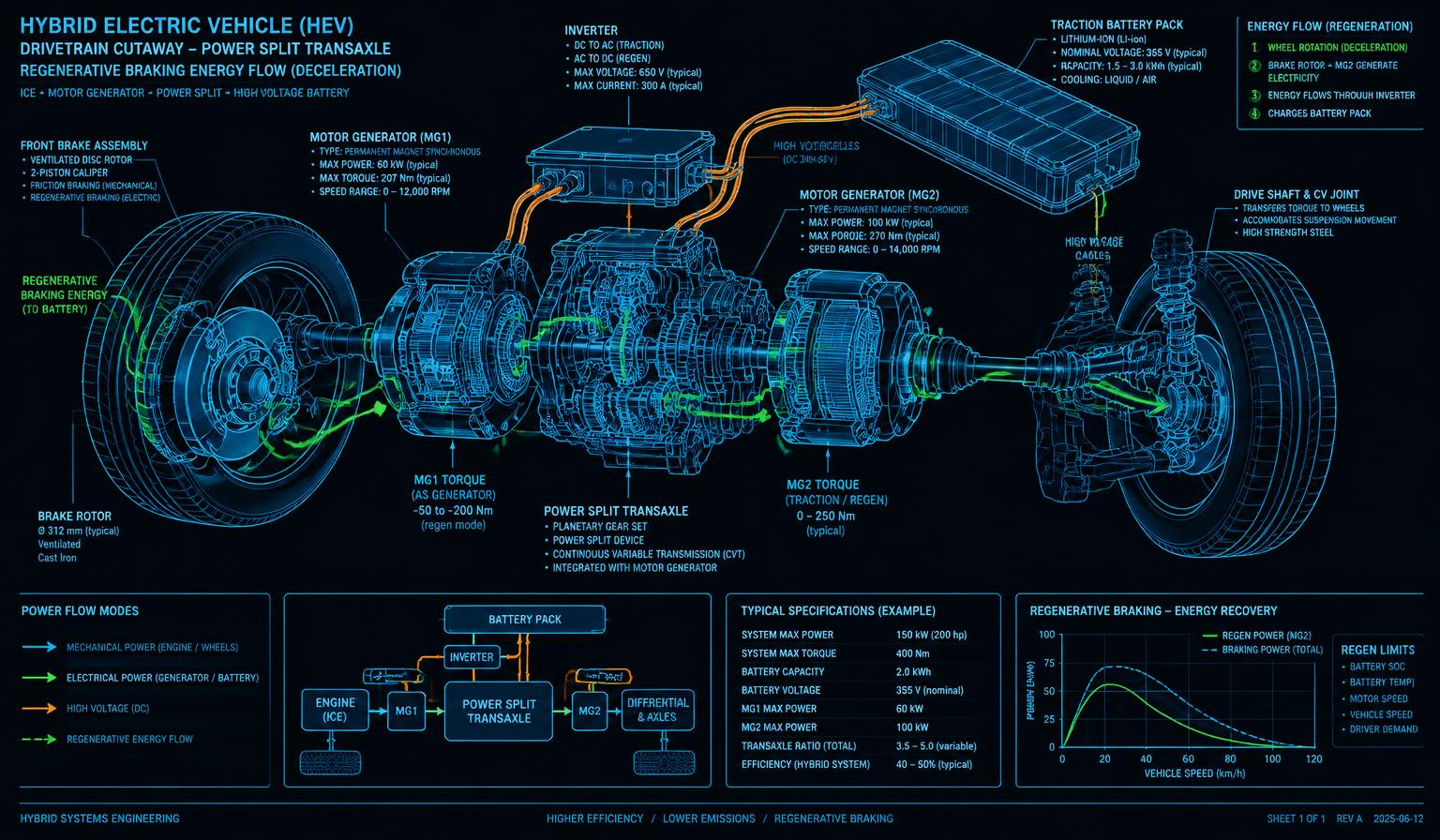
Reference diagram of how energy moves in a ZVW30. EV: pack feeds MG2 through the inverter. Engine + assist: the planetary gear splits engine torque between the wheels and MG1, which charges or feeds MG2. Regen: MG2 becomes a generator and returns energy to the pack.
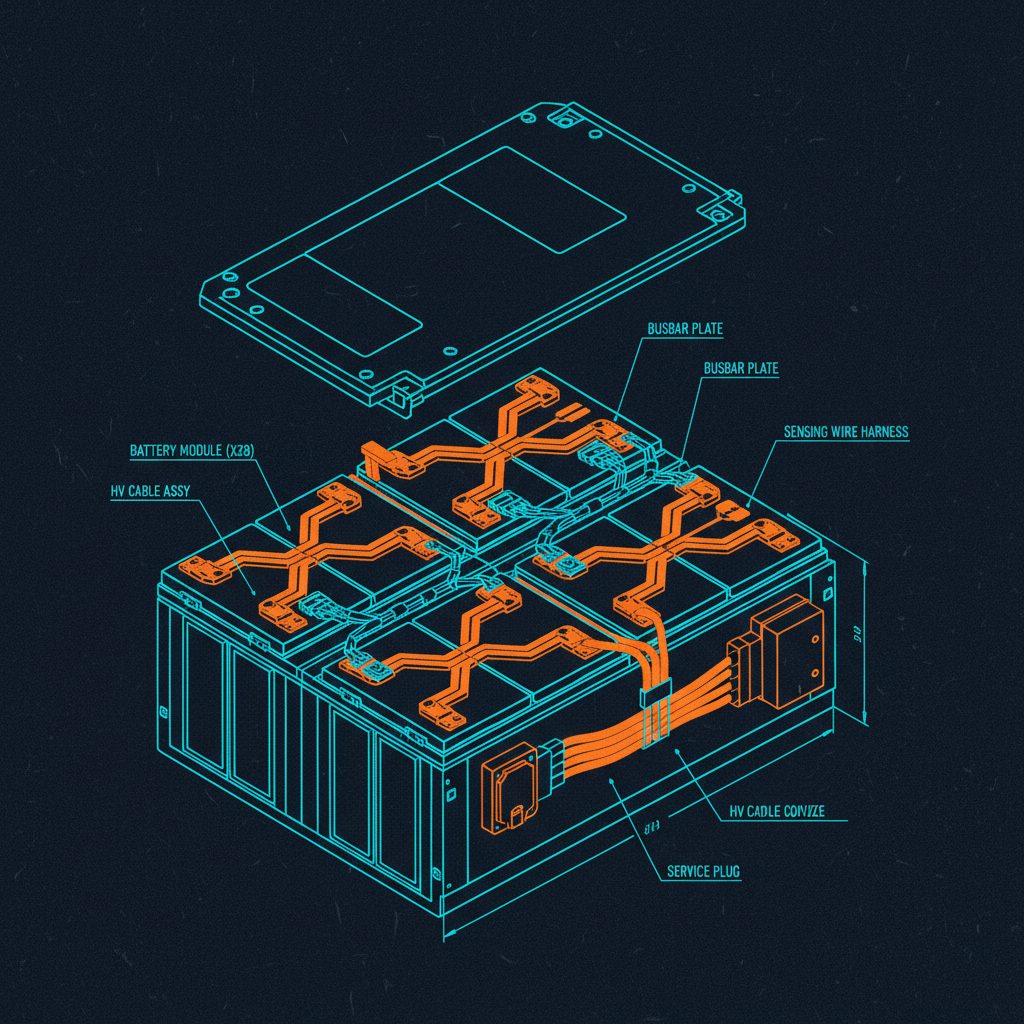
Tap a module to see its sense block
28 × 7.2 V prismatic NiMH modules in series (201.6 V). The battery ECU reads voltage in 14 blocks of two modules, so a Cell Δ warning points to a pair, not a single module. The orange service plug splits the string mid-pack; the junction block holds the system main relays, precharge resistor and current sensor.
Audit Matrix
This is the ingest engine with the covers off. Drag a variance and every downstream number — bench hours, parts, core credit, the BHI score an underwriter would buy — recomputes on the same coefficients the live network uses.
Simulated stream. Field units publish the identical frame layout over the Pulse OBD-II link.
- Pack bus voltage207.8 V
- Worst cell delta84 mV
- Weak modules flagged7 of 28
- Isolation resistance1.80 MΩ
- HV AC compressor draw11.4 A
- Steering rack nodeNominal
- Brake booster accumulatorNominal · 2.1 s recharge
- Coolant loop ΔT6.3 °F
- Inverter switching temp138 °F
- 12 V accessory rail13.9 V · load-tested
Signal Bands
A reading is mapped to its chassis family first, then to one shared four-band verdict. The same millivolt spread that is routine on a hybrid pack is an emergency on a lithium one, so the band — not the raw number — decides what happens next.
The four bands
- Normal
Within working band. No action beyond the standing record.
- Monitoring
Off the usual range but stable. Re-read on the next drive cycle.
- Warning
Outside the working band. Book a bay read before more charge cycles.
- Critical
Stop charging, stop the cycle, and escalate to a two-tech bay check.
Colour never carries the meaning on its own. Every band also carries a written instruction, so the reading still works in greyscale or for a tech who cannot separate two hues.
Same reading, different chassis
Tight voltage window. A 25 mV resting spread is already a monitoring flag, and thermal gradient outranks everything else.
Worked example · fixed numbers · not a live vehicle reading