Cooling Kits
Heat kills hybrid batteries. Pick your car, tap through the cutaway to see every part, then drag the heat test to see what the kit is designed to do.
Air-Cooled Vent Kit · cutaway schematic · tap a hotspot
Heat test · drag the outside temperature
100°F
Illustration built from the kit's design target (Peak pack temp ↓ 16–25°F in summer traffic). Real results depend on driving, climate and pack condition — the temp logger records your actual numbers.
Every 15°F hotter roughly doubles how fast battery chemistry ages — that's why cooling is the cheapest pack-life upgrade.
Vehicle Fitment
- Matching kit
- HHN-AIR-P2
- Where the cooling intake is
- Cabin-air grille beside the rear seat, passenger side; blower behind the trim.
- What to check
- Inspect and vacuum the grille and blower at every oil change; more often with pets or dusty roads.
- Warning signs
- Loud battery fan, reduced EV mode, P0A80 or P0A7F after hot drives.
- Limitations & safety
- Won't revive modules that already have high internal resistance — test the pack first.
Typical locations — confirm with your vehicle's service information. Kit gains and prices are design targets, not measured results. HV work requires a trained technician.
Cooling Savings
Pick a kit, climate, and duty cycle. We model peak pack temperature and project pack life using an Arrhenius rule of thumb (every 18°F drop ≈ doubles calendar life), clamped by climate and load stress.
Closed-loop liquid cooling — ΔT tightly controlled.
HHN logger ±, NTC sensor drift, install seating
Arrhenius extrapolation error, ΔT × climate stress
Cell aging spread, prior abuse history, BMS calibration
Sources are assumed independent and combined in quadrature: σ_total = √(σ_meas² + σ_model² + σ_pack²). Pack variability dominates on air kits; model variance dominates in extreme climates. Each new HHN-stamped install shrinks the band.
The shaded band on the HHN cooled bar shows the low–high confidence range — worst case assumes degraded ΔT (≈70% of stated drop) and heavier stress drag; best case assumes a clean install and lighter stress. The solid fill is the point estimate. Model recalibrates quarterly from Oracle install telemetry.
What we assume
- • A stock pack running hot ages faster. We start from typical peak temperatures seen in real-world driving and add stress for hotter climates or harder use.
- • Baseline pack life is about 8–10 years under moderate conditions. Harsher climates and heavy duty cycles shorten that; cooling extends it.
- • Every kit is tested for real temperature drop, not just lab theory. The numbers you see are field midpoints — we also model a worst-case install at roughly 70% of the stated drop.
- • Cooling can only take a pack down to about 82°F — the limit of cabin air conditioning — so we floor the estimate there.
The core idea
Battery chemistries age more slowly when they run cooler. A well-known rule of thumb in the industry says that for every 18°F you drop a battery's peak temperature, you can roughly double its calendar life. We blend that physical principle with HHN's own field data — actual temperature drops and long-term performance from installs — then adjust for how hard the climate and driving style stress the pack. The result is a realistic range, not a sales pitch.
Where the data comes from
- • Published battery-aging research from NREL, peer-reviewed journals, and Battery University.
- • Real Prius and Camry Hybrid pack telemetry from HHN-stamped installs and community field logs.
- • NOAA regional climate normals to set realistic ambient-heat baselines across the US.
- • HHN bench testing and early-install logger data (via Oracle) for actual kit temperature drops.
Supply network & full program details
Thermal Defense
Heat is the #1 killer of NiMH and Li-ion packs. HHN-certified upgraded air and liquid-cooling kits — designed first for the simplest platforms (Prius + Camry) — give every owner +35–110% projected pack life. Every kit pulls a new trade into the network.
Prius Gen 2 (NHW20)
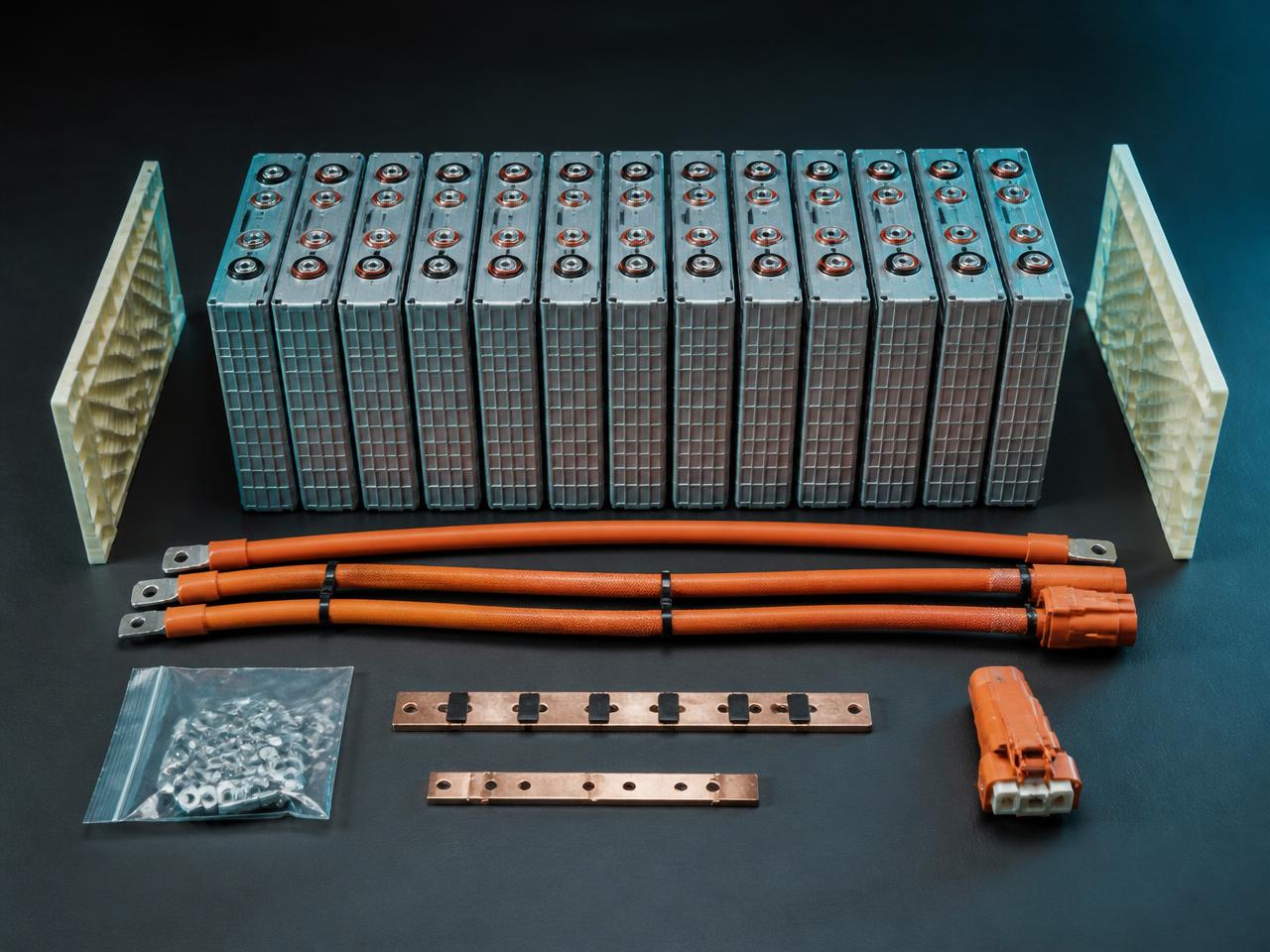
Added rear-deck intake vents, high-flow HV blower, sealed cabin-air duct, washable HEPA pre-filter, HHN temp logger.
Peak pack temp ↓ 16–25°F in summer traffic. Projected pack life +35–60%.
$340 parts / $180 install
Prius Gen 3 (ZVW30)
Twin-blower upgrade, two added rear-deck exhaust vents, fresh thermal pads, ducted intake, HHN logger.
Peak pack temp ↓ 20–29°F. Module temperature spread cut in half. +40–70% projected life.
$420 parts / $210 install
Prius Gen 4 (ZVW50)

Slim cold-plate jacket wrapped around the pack, micro-pump, sealed glycol loop, AC-side heat exchanger tie-in, BMS-aware controller.
Peak pack temp held at or below 90°F even at 110°F ambient. +60–110% projected life.
$1,180 parts / $640 install
Camry Hybrid (XV40/XV50/XV70)
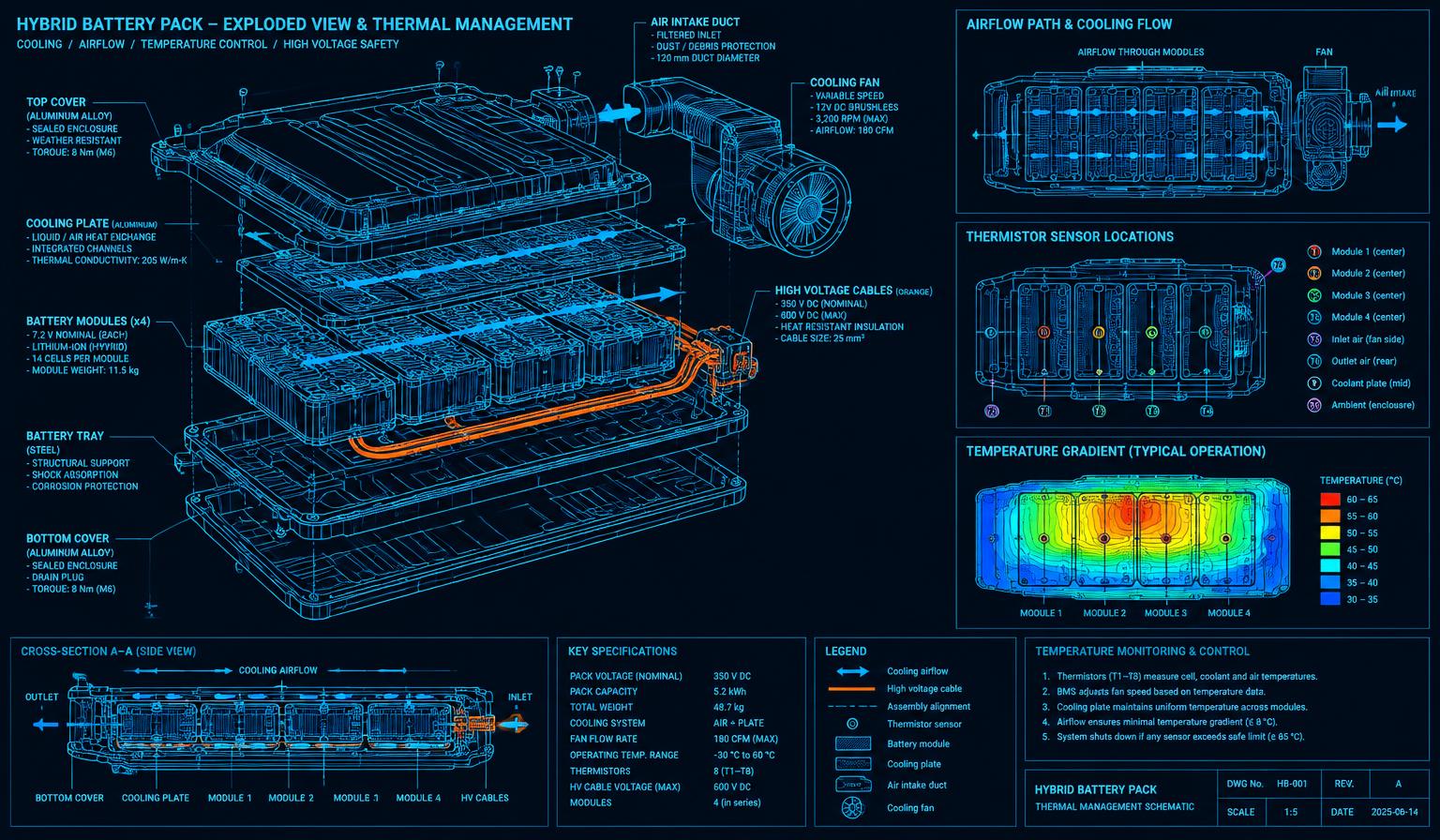
Stamped cold-plate box that replaces the OEM pack tray, brushless pump, expansion tank, HHN-certified harness, BMS-aware controller.
Eliminates trunk heat-soak. Pack-life parity with EV-grade cooled packs.
$1,290 parts / $720 install
Owner books a cooling kit
Pulse app prices the kit for their VIN — parts, install, projected pack-life gain in months.
Network sources the parts
Stamping shop presses plates. CNC shop mills brackets. PCBA partner ships the controller. All listed on The Market.
L2/L3 shop installs + stamps
Certified tech installs, runs HHN-stamped acceptance test, logs baseline temps to the ledger.
Insurance + data revalue the car
Lower pack-failure risk → insurer cuts premium. Resale value re-rated by Oracle with cooled-pack curve.
Royalty flows back out
Every kit sold pays the stamping shop, the molder, the PCBA, the installer, the HHN ledger — and tops up the HUB rewards pool.
// The reach
One stamped cooling kit touches a stamping plant, a CNC shop, a plastics molder, a PCBA line, a coolant supplier, an HVAC tech, an insurance underwriter, and a mobile installer. That's eight trades fed by a single $1,200 kit — and the owner gets a pack that lasts twice as long. HHN doesn't just route hybrid work. It pulls manufacturing, plastics, electronics, fluids, insurance, and skilled trades into the same network — and creates jobs at every node.
Thermal Control
This is the whole program, in order, with nothing bundled together to hide behind. Read the reason, pick the stage that matches your chassis and climate, and see the number it moves.
Heat is the degradation clock
Cell aging roughly doubles for every 18°F above about 86°F. A pack that lives at 113°F in summer traffic ages several times faster than the same pack held near 86°F, even with identical mileage.
The damage is uneven
Center modules sit in the hottest air with the least airflow. They lose capacity first, the pack balances to the weakest module, and the whole pack presents as dead when most of it is fine.
Cooling buys capacity back indirectly
Cooling does not raise the state of health you already lost. It flattens the curve from here forward — less cell-to-cell spread, less internal resistance growth, fewer forced regen limits.
It is measurable, not a claim
Every kit ships with a logger. Baseline temperatures are recorded before the install and after, and both land on the ledger. The gain is a number you can read, not a promise on a box.
Aging roughly doubles for every 18°F of sustained pack temperature above about 86°F. Shape is modelled from published cell-aging behaviour, not a measurement of your car.
Center banks run hottest with the least airflow, so they fail first and the pack balances down to them. Cooling narrows the spread, which is the number that decides how long the pack survives.
Baseline aging. Full regen and charge power available.
Aging roughly 2× baseline. Cell-to-cell spread starts to open.
Aging 4–6× baseline. BMS trims regen and assist to protect cells.
Permanent capacity loss per event. Repeated exposure ends the pack early.
Modelled from published pack thermal limits and the Arrhenius aging rule. Field units log the real numbers.
You set the departure time
In the app, you tell the car when you're leaving — once, or as a weekday pattern. Nothing else is required of you.
Controller wakes the HV circuit only
An hour out, the controller brings up the high-voltage bus and the existing electric AC compressor. The engine never starts. Drive is never engaged.
Chilled air is routed at the pack
The added fan and duct pull conditioned air across the pack while ambient and cabin sensors watch the delta, exactly like the electric power-steering pump arrangement it borrows from.
It stops on target, not on a timer
The loop shuts down when the pack hits its target band or the traction battery drops below the reserve floor — whichever comes first. It will never strand you.
The session is logged
Start temperature, end temperature, energy used and ambient conditions post to the ledger, so the long-term thermal benefit is provable at resale and to an underwriter.
Pulse records pack voltage, per-module resting voltage, worst delta, internal resistance estimate and isolation before disassembly. This is the baseline nobody can rewrite later.
Each module is cycled individually on a load bank. Capacity, resistance and self-discharge are recorded against the module's etched serial.
Most pack failures are one or two modules dragging the block. The ledger shows which ones, so the shop is not paid to replace what's healthy.
Graded modules are selected within a tight capacity and resistance band of the survivors. Mismatch is the reason cheap rebuilds fail in 18 months.
Macro photos of each etched serial are read and hashed into the entry, so one premium module cannot be claimed across several cars.
Post-rebuild delta, isolation and a full charge/discharge cycle are recorded. The tech's certified key and the shop's tool-calibration hash sign the entry together.
The extracted modules are scanned onto the ledger with their retired SOH. The shop's core credit only unlocks once a downstream node confirms receipt.
Retired at 60–70% SOH
Too weak for highway load, entirely adequate for stationary duty where discharge is slow and predictable.
Graded and matched into strings
Modules are re-tested, sorted into matched strings and fitted with a stationary BMS. Grade and history follow the serial.
Garage or camp power wall
A 28-module NiMH set or a handful of Li-ion modules typically yields 2–6 kWh usable — enough for lights, a fridge, tools or a night of camp draw.
Paired with solar
Charged from panels during the day, discharged into the garage circuit or a portable setup at night, buffering peak utility rates.
Material recovery at true end of life
When a module can no longer hold a stationary charge it goes to a certified recycler with its whole ledger history, so nickel, cobalt and copper recovery is documented, not assumed.